Netherfield Ball
The Netherfield Ball is the grand social set-piece of Jane Austen's Pride and Prejudice, the long-anticipated evening at Charles Bingley's rented estate that gathers the principal families of Hertfordshire into one brightly lit room. It is the moment when the novel's central tensions—Elizabeth Bennet's hardening prejudice, Fitzwilliam Darcy's wounded pride, George Wickham's mysterious absence, and the Bennet family's public impropriety—are all brought to a head in a single, glittering night. More than a mere dance, the ball functions as a stage on which social rank, personal character, and romantic possibility are performed, judged, and irrevocably altered, making it the decisive turning point that shapes the courtships and conflicts of the entire narrative.
The Anticipation and the Absence of Wickham
The ball had been promised since Bingley's first arrival in the neighbourhood, and its prospect filled the Bennet household with eager expectation. Mrs. Bennet chose to consider it as given in compliment to her eldest daughter, and was particularly flattered by receiving the invitation from Mr. Bingley himself, rather than a ceremonious card. Jane pictured to herself a happy evening in the society of her two friends and the attentions of their brother, while Elizabeth thought with pleasure of dancing a great deal with Mr. Wickham, and of seeing a confirmation of everything in Mr. Darcy's look and behaviour. The younger girls, Catherine and Lydia, meant to dance half the evening with Wickham, though a ball was, at any rate, a ball to them. Even Mary could assure her family that she had no disinclination for it, provided she could keep her mornings to herself.
Elizabeth's high spirits, however, were dashed the moment she entered the drawing-room at Netherfield and looked in vain for Mr. Wickham among the cluster of red coats there assembled. The dreadful suspicion arose that he had been purposely omitted for Mr. Darcy's pleasure in the Bingleys' invitation to the officers. Though this was not exactly the case, the absolute fact of his absence was pronounced by his friend Mr. Denny, to whom Lydia eagerly applied, and who told them that Wickham had been obliged to go to town on business the day before, and was not yet returned. Denny added, with a significant smile, that he did not imagine Wickham's business would have called him away just now, if he had not wanted to avoid a certain gentleman here. This part of his intelligence, though unheard by Lydia, was caught by Elizabeth, and it assured her that Darcy was not less answerable for Wickham's absence than if her first surmise had been just. Every feeling of displeasure against Darcy was so sharpened by immediate disappointment that she could hardly reply with tolerable civility to the polite inquiries which he directly afterwards approached to make. Attendance, forbearance, patience with Darcy, was injury to Wickham, and she was resolved against any sort of conversation with him.
The Mortifying Dances with Mr. Collins
Elizabeth's evening began in misery, for the first two dances were dances of mortification. Mr. Collins, awkward and solemn, apologising instead of attending, and often moving wrong without being aware of it, gave her all the shame and misery which a disagreeable partner for a couple of dances can give. He had solicited her hand for the two first dances especially, a preference which he trusted her cousin Jane would attribute to the right cause, and not to any disrespect for her. Elizabeth felt herself completely taken in, having fully proposed being engaged by Mr. Wickham for those very dances. The moment of her release from Mr. Collins was ecstasy. She danced next with an officer, and had the refreshment of talking of Wickham, and of hearing that he was universally liked. When those dances were over, she returned to Charlotte Lucas, and was in conversation with her when she found herself suddenly addressed by Mr. Darcy, who took her so much by surprise in his application for her hand that, without knowing what she did, she accepted him.
The Verbal Duel with Mr. Darcy
Darcy walked away again immediately, and Elizabeth was left to fret over her own want of presence of mind. Charlotte tried to console her, saying she dared say she would find him very agreeable, to which Elizabeth replied that Heaven forbid, for that would be the greatest misfortune of all—to find a man agreeable whom one is determined to hate. When the dancing recommenced and Darcy approached to claim her hand, Charlotte cautioned her in a whisper not to be a simpleton, and allow her fancy for Wickham to make her appear unpleasant in the eyes of a man ten times his consequence. Elizabeth took her place in the set, amazed at the dignity to which she was arrived in being allowed to stand opposite to Mr. Darcy, and reading in her neighbours' looks their equal amazement in beholding it.
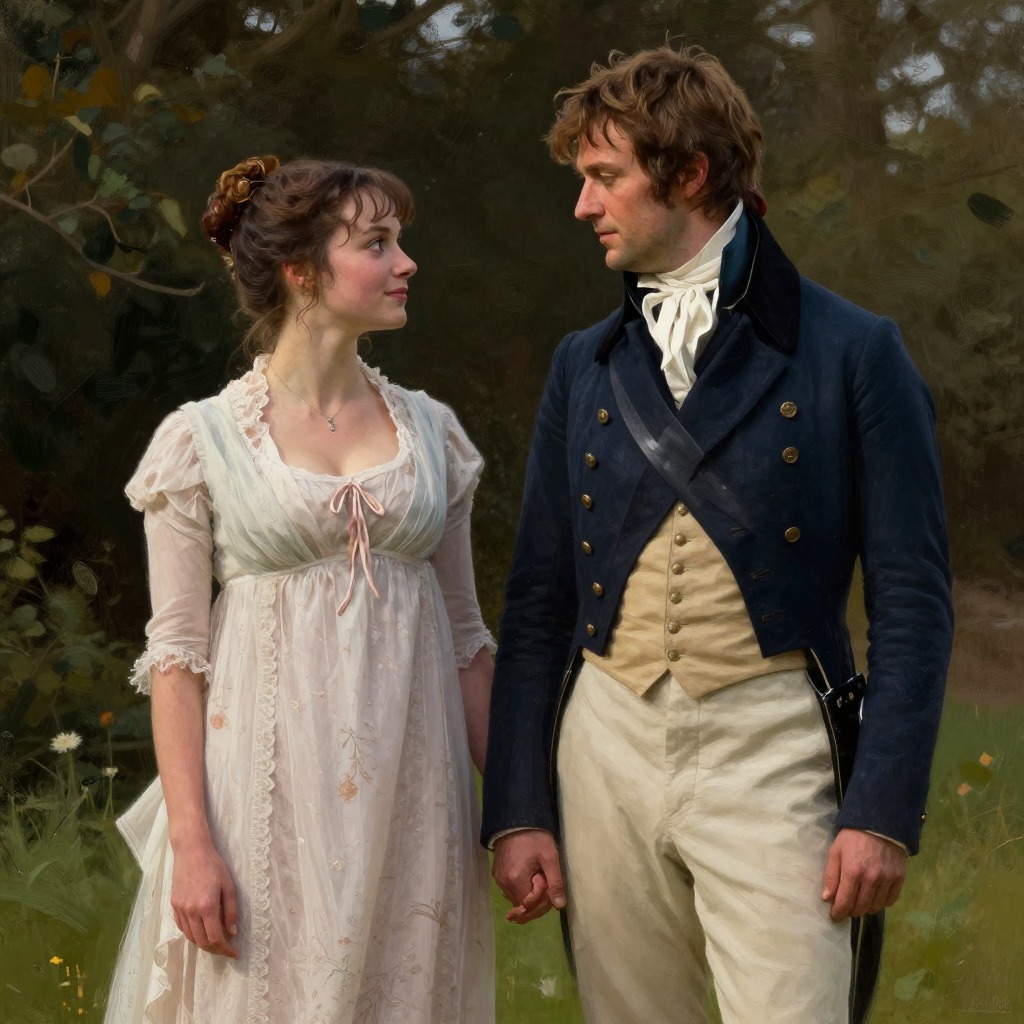
They stood for some time without speaking a word, and she began to imagine that their silence was to last through the two dances, till suddenly fancying that it would be the greater punishment to her partner to oblige him to talk, she made some slight observation on the dance. He replied, and was again silent. After a pause of some minutes, she addressed him a second time, saying it was his turn to say something now, that she had talked about the dance, and he ought to make some sort of remark on the size of the room, or the number of couples. He smiled, and assured her that whatever she wished him to say should be said. Their conversation turned into a witty, barbed exchange about their respective dispositions, with Elizabeth declaring they were each of an unsocial, taciturn disposition, unwilling to speak unless they expected to say something that would amaze the whole room. Darcy replied that this was no very striking resemblance of her own character, and asked how near it might be to his.
When Elizabeth, unable to resist the temptation, mentioned that she and her sisters had just been forming a new acquaintance when they met Darcy and Bingley in Meryton, the effect was immediate. A deeper shade of hauteur overspread his features, but he said not a word. At length Darcy spoke, and in a constrained manner said that Mr. Wickham was blessed with such happy manners as may ensure his making friends—whether he might be equally capable of retaining them, was less certain. Elizabeth replied with emphasis that Wickham had been so unlucky as to lose Darcy's friendship, and in a manner which he was likely to suffer from all his life. Darcy made no answer, and seemed desirous of changing the subject. Their dance ended in silence, and on each side dissatisfied, though not to an equal degree, for in Darcy's breast there was a tolerably powerful feeling towards her, which soon procured her pardon, and directed all his anger against another.
The Exposure of the Bennet Family
The ball also became the stage for the Bennet family's most public embarrassments. Mrs. Bennet, seated at supper next to Lady Lucas, talked freely and openly of nothing else but her expectation that Jane would soon be married to Mr. Bingley. She enumerated the advantages of the match with an animating subject, incapable of fatigue—his being such a charming young man, and so rich, and living but three miles from them. Elizabeth, in inexpressible vexation, could perceive that the chief of it was overheard by Mr. Darcy, who sat opposite to them. Her mother only scolded her for being nonsensical, declaring that she was sure they owed Mr. Darcy no such particular civility as to be obliged to say nothing he may not like to hear. Elizabeth blushed and blushed again with shame and vexation, and could not help frequently glancing her eye at Mr. Darcy, though every glance convinced her of what she dreaded; the expression of his face changed gradually from indignant contempt to a composed and steady gravity.
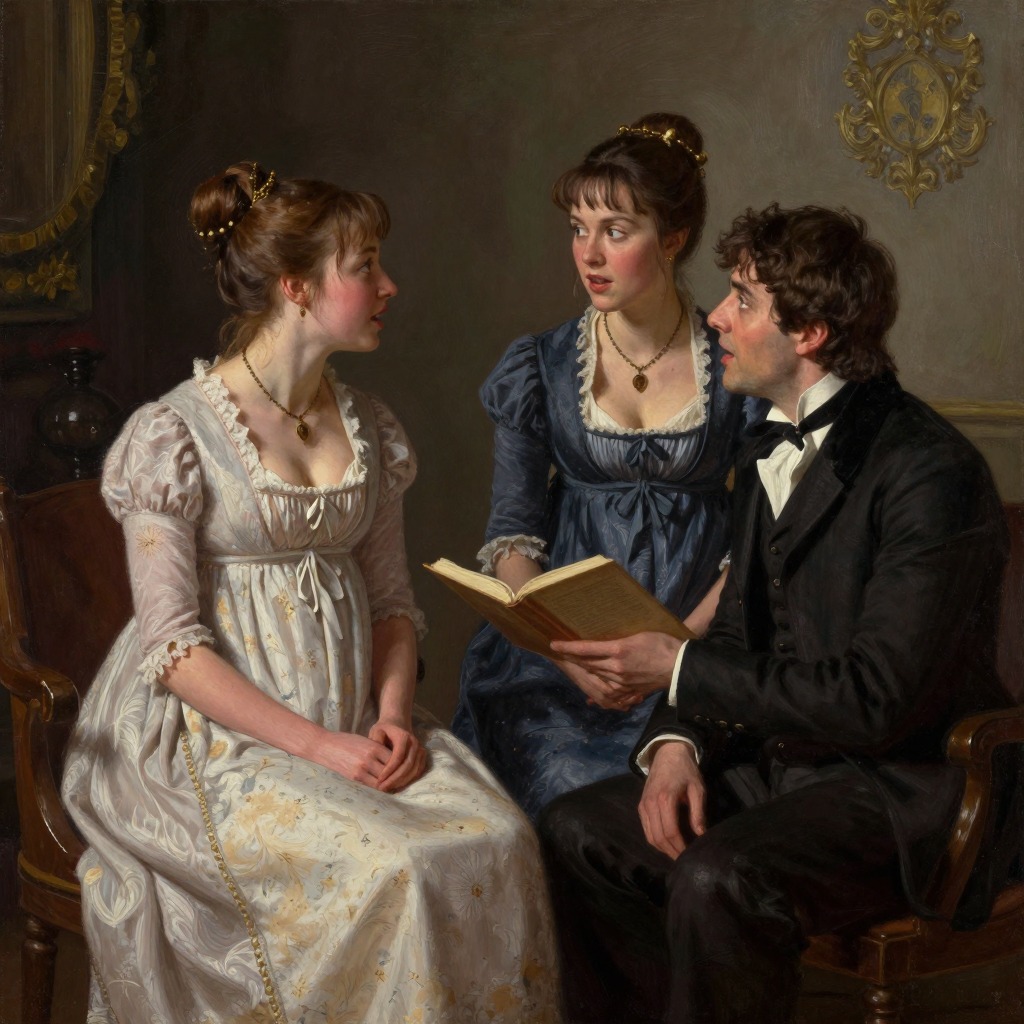
Further mortification came when Mary, after very little entreaty, prepared to oblige the company with a song. Elizabeth's eyes were fixed on her with most painful sensations, and she watched her progress through the several stanzas with an impatience which was very ill rewarded at their close, for Mary, on receiving the hint of a hope that she might be prevailed on to favour them again, after the pause of half a minute began another. Mary's powers were by no means fitted for such a display; her voice was weak, and her manner affected. Elizabeth was in agonies, looking at Jane, who was very composedly talking to Bingley, and at his two sisters, who were making signs of derision at each other. She looked at her father to entreat his interference, and he took the hint, saying aloud when Mary had finished her second song, "That will do extremely well, child. You have delighted us long enough. Let the other young ladies have time to exhibit."
Mr. Collins also distinguished himself by his absurdity. He had discovered, by a singular accident, that there was in the room a near relation of his patroness, Lady Catherine de Bourgh, and insisted on introducing himself to Mr. Darcy, despite Elizabeth's earnest attempts to dissuade him. He prefaced his speech with a solemn bow, and though she could not hear a word of it, she saw in the motion of his lips the words "apology," "Hunsford," and "Lady Catherine de Bourgh." Mr. Darcy was eyeing him with unrestrained wonder, and replied with an air of distant civility. Mr. Collins, however, was not discouraged, and Mr. Darcy's contempt seemed abundantly increasing with the length of his second speech, at the end of which he only made him a slight bow and moved another way. Mr. Collins returned to Elizabeth, declaring himself much pleased with his reception, and that Mr. Darcy had even paid him the compliment of saying he was so well convinced of Lady Catherine's discernment as to be certain she could never bestow a favour unworthily.
The Confrontation over Wickham's Character
In the midst of the evening, Miss Bingley approached Elizabeth with an expression of civil disdain, and accused her of being quite delighted with George Wickham. She revealed that Wickham was the son of old Wickham, the late Mr. Darcy's steward, and recommended Elizabeth, as a friend, not to give implicit confidence to all his assertions. Miss Bingley declared that as to Mr. Darcy's using him ill, it was perfectly false, for on the contrary, he had always been remarkably kind to him, though George Wickham had treated Mr. Darcy in a most infamous manner. Elizabeth answered angrily that his guilt and his descent appeared by Miss Bingley's account to be the same, for she had heard her accuse him of nothing worse than being the son of Mr. Darcy's steward, and of that, he had informed her himself. Miss Bingley turned away with a sneer, saying her interference was kindly meant. Elizabeth said to herself that Miss Bingley was an insolent girl, much mistaken if she expected to influence her by such a paltry attack, seeing nothing in it but her own wilful ignorance and the malice of Mr. Darcy.
Elizabeth then sought her eldest sister, who had undertaken to make inquiries on the same subject of Bingley. Jane met her with a smile of such sweet complacency, a glow of such happy expression, as sufficiently marked how well she was satisfied with the occurrences of the evening. Jane reported that Mr. Bingley did not know the whole of Wickham's history, and was quite ignorant of the circumstances which had principally offended Mr. Darcy, but he would vouch for the good conduct, the probity, and honour of his friend, and was perfectly convinced that Mr. Wickham had deserved much less attention from Mr. Darcy than he had received. Jane was sorry to say that by his account as well as his sister's, Mr. Wickham was by no means a respectable young man, and she was afraid he had been very imprudent, and had deserved to lose Mr. Darcy's regard. Elizabeth, however, was not convinced by assurances only, since Bingley was unacquainted with several parts of the story and had learnt the rest from that friend himself.
The Aftermath and Significance
The ball concluded with the Longbourn party being the last of all the company to depart, and by a manoeuvre of Mrs. Bennet, they had to wait for their carriage a quarter of an hour after everybody else was gone, which gave them time to see how heartily they were wished away by some of the family. Mrs. Hurst and her sister scarcely opened their mouths, except to complain of fatigue, and were evidently impatient to have the house to themselves. Darcy said nothing at all, while Mr. Bennet, in equal silence, was enjoying the scene. Mr. Bingley and Jane were standing together, a little detached from the rest, and talked only to each other. Mrs. Bennet was most pressingly civil in her hope of seeing the whole family soon at Longbourn, and addressed herself especially to Mr. Bingley, to assure him how happy he would make them by eating a family dinner with them at any time. Bingley was all grateful pleasure, and readily engaged for taking the earliest opportunity of waiting on her, after his return from London, whither he was obliged to go the next day for a short time.
Mrs. Bennet quitted the house under the delightful persuasion that, allowing for the necessary preparations of settlements, new carriages, and wedding clothes, she should undoubtedly see her daughter settled at Netherfield in the course of three or four months. Of having another daughter married to Mr. Collins, she thought with equal certainty, and with considerable, though not equal, pleasure. The ball, however, had far more profound consequences than Mrs. Bennet's sanguine hopes. It was the evening on which Darcy, having witnessed the total want of propriety betrayed by Mrs. Bennet, her three younger sisters, and occasionally even her father, confirmed his opinion that Jane's connection was a most unhappy one for his friend. His letter to Elizabeth later revealed that it was at this very ball, while he had the honour of dancing with her, that he was first made acquainted, by Sir William Lucas's accidental information, that Bingley's attentions to her sister had given rise to a general expectation of their marriage, and from that moment he observed his friend's behaviour attentively, resolving to detach him from the match. The ball thus became the catalyst for Darcy's intervention, the source of Elizabeth's deepest prejudice, and the public spectacle that would shape the fates of both couples.